If you run a small business, "risk assessment" is probably the health and safety task you know you should do and keep putting off. Partly because it sounds like paperwork, and partly because nobody's ever explained it plainly.
Here's the plain version.
What a risk assessment actually is
A risk assessment is you, thinking systematically about what in your work could hurt someone, and deciding what you're doing about it. That's the whole idea. Not a form. Not a binder. A structured look at your own work, recorded so you can show your thinking and act on it.
The five steps
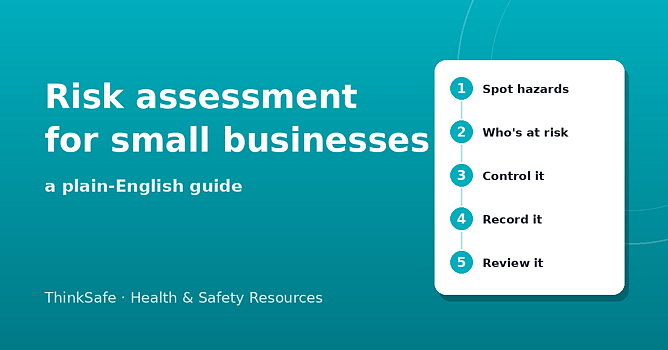
Spot the hazards. Walk the job. What could realistically cause harm — equipment, substances, vehicles, working at height, lone work, even workload? Ask your team; they see risks you don't.
Work out who could be harmed and how. Your workers, obviously — but also visitors, contractors, customers, the public. New starters and young workers often face the same hazard with less experience.
Decide what you're doing about each one. Can you remove the hazard entirely? If not, can you reduce it — different equipment, a changed process, training, protective gear as the last line? You're not aiming for zero risk; you're aiming for risk that's controlled as far as is reasonably practicable.
Record it. Write down the significant findings: the hazard, who's at risk, what you're doing about it. In the UK, if you have fewer than five employees you're not legally required to write it down — but a written record is still the thing that proves your thinking, briefs your team, and holds up when a client or insurer asks.
Review it when things change. New equipment, new people, a near miss, a new site — each one is a prompt to look again. A risk assessment from three years ago describes a business that no longer exists.
Where small businesses go wrong
The most common failure isn't doing no assessment — it's downloading a generic template, changing the company name, and filing it. A document that describes work you don't do protects nobody and impresses no inspector.
The second failure is treating it as a one-off: assessed once, never looked at again.
The third is keeping it a secret — an assessment your team has never seen can't change how anyone works.
Making it a living system instead of a document
The businesses that do this well don't have better paperwork — they have a simpler loop: hazards get reported when they're spotted, someone's assigned to deal with them, and the record updates itself as work changes.
That's exactly what ThinkSafe Go is built for: hazard reporting from any phone, corrective actions assigned and tracked, and your risk documentation maintained as part of the day job rather than an annual scramble. It arrives pre-loaded and ready to use. Start a free trial →